
{"@context":"https://schema.org","@type":"BreadcrumbList","itemListElement":[{"@type":"ListItem","position":1,"name":"Home","item":"https://gcaflex.com/"},{"@type":"ListItem","position":2,"name":"Flex vs Rigid","item":"https://gcaflex.com/flexible-circuits-compared-to-a-rigid-board/"}]}
{"@context":"https://schema.org","@type":"Organization","@id":"https://gcaflex.com/#organization","name":"GC Aero Flexible Circuits, Inc.","alternateName":["GCA Flex","GC Aero Flex"],"url":"https://gcaflex.com","logo":{"@type":"ImageObject","url":"https://gcaflex.com/wp-content/uploads/2026/04/GC_AERO_logo-300x93-1.png"},"telephone":"844-359-3539","email":"mario@gcaflex.com","address":{"@type":"PostalAddress","streetAddress":"24418 S. Main St. Suite #406","addressLocality":"Carson","addressRegion":"CA","postalCode":"90745","addressCountry":"US"},"foundingDate":"1990","knowsAbout":["Flexible Circuits","Flex PCB","Rigid-Flex","Multilayer Flex","Single-Sided Flex","Aerospace Flex Circuits","Medical Flex Circuits","KAPTON Polyimide"],"hasCredential":[{"@type":"EducationalOccupationalCredential","name":"ISO 9001:2008"},{"@type":"EducationalOccupationalCredential","name":"ITAR Registration"},{"@type":"EducationalOccupationalCredential","name":"TS 16949"}]}
{"@context":"https://schema.org","@type":"Article","headline":"Flexible Circuits vs Rigid PCBs u2014 Detailed Engineering Comparison","description":"Flex circuits vs rigid PCBs: 85% thinner, 70% lighter, 75% space savings, 500M flex cycles, eliminated wiring errors. Detailed comparison."}
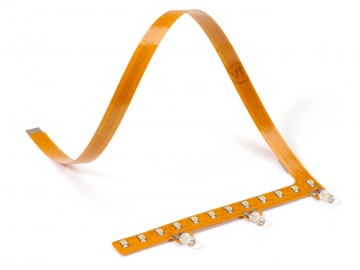
Engineering Comparison
Flexible Circuits vs. Rigid PCBs
Every dimension engineers use to make the flex vs. rigid decision — objectively compared.
| Characteristic | Rigid PCB | Flex Circuit | Flex Advantage |
|---|---|---|---|
| Thickness | ~62 mils (1.57mm) | 4–11 mils (0.1–0.28mm) | Up to 85% thinner |
| Weight | Baseline | Up to 70% lighter | Dramatic reduction |
| Space | Planar only | Up to 75% savings | 3D geometry enabled |
| Geometry | Flat, rigid | Bend, fold, twist, roll | Unlimited 3D shapes |
| Dynamic Flex Life | ~1,000 cycles | Up to 500 million | 500,000× more durable |
| Vibration & Shock | Moderate | Excellent (KAPTON) | Harsh environment rated |
| Wiring Errors | Possible | Eliminated | Zero errors |
| Connectors | Many | Minimal or none | Fewer failure modes |
| Assembly Labor | High | Low (integrated) | Reduced cost |
| Thermal | Standard | Higher (larger surface) | Better dissipation |
| Reliability | Good | Excellent | Superior long-term |
| Proto Cost | Lower | Slightly higher | Rigid may be preferred |
Decision Framework
When to Choose Flex Circuits
Space is Constrained
When your product must be smaller than rigid board interconnections allow. Flex routes in 3D, eliminates connector housings, and folds into available space. Up to 75% savings.
Weight Must Be Minimized
Aerospace, defense, wearable medical, portable electronics. 70% weight savings versus rigid assemblies. When every gram matters, flex is the answer.
Dynamic Flexing Required
Moving parts — hinges, rotating assemblies, folding mechanisms. Only flex circuits survive millions of flex cycles without fracturing.
Reliability is Critical
Every connector eliminated is a failure mode removed. For aerospace, defense, and medical, flex circuit integration improves system MTBF significantly.
Harsh Environments
Vibration, shock, thermal cycling, chemical exposure. KAPTON handles all of these far better than rigid boards with discrete connectors and wire harnesses.
High Production Volume
Integrated assembly advantage compounds at volume — one flex assembly installed vs. multiple boards, connectors, and wiring. Significant cost savings per unit.
For more on this topic, see: FPC flex-to-rigid.
Further reading: flexible printed circuits.
Further reading: Industries Applications.
Further reading: the history of flexible circuits.
Ready to Start Your Project?
30+ years of flex circuit expertise. Quick turnarounds. ISO 9001 certified. ITAR registered.